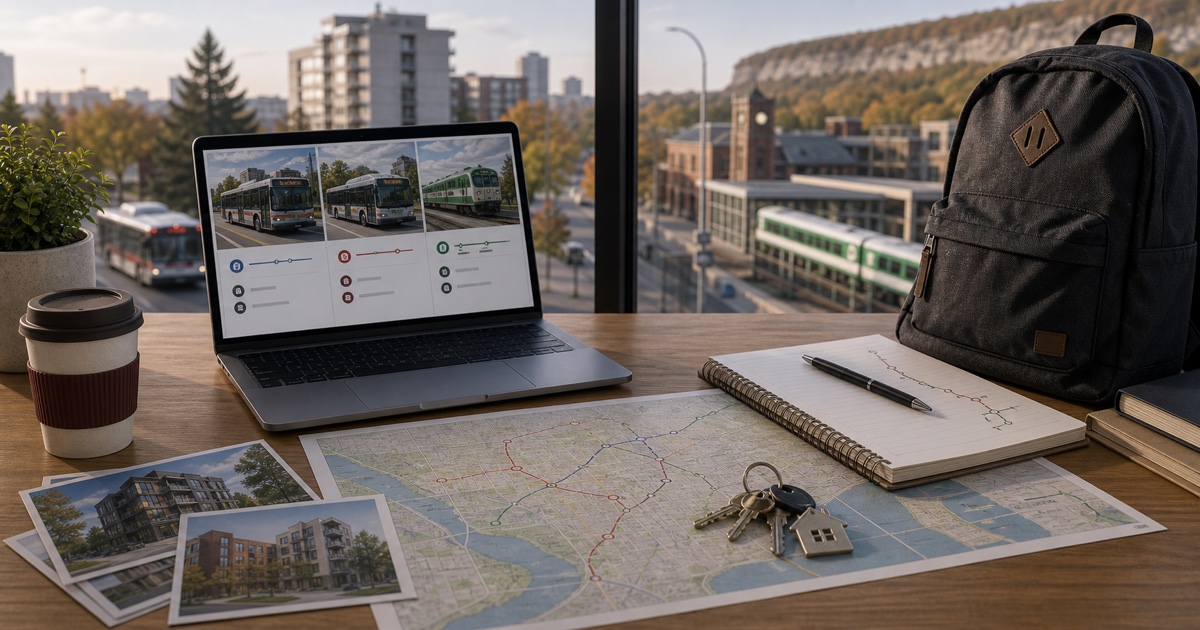
McMaster Transit and Commute Guide: HSR, 10 Bay, GO Connections, and How Hamilton Geography Changes Housing Choice
A commute-focused guide for McMaster University housing. Uses City of Hamilton and McMaster transit information to explain how students should compare campus-adjacent living with downtown Hamilton, 10 Bay shuttle service, and GO-linked mobility.
Updated 2026-05-18
This article is organized from 4 public sources, last fact-checked 2026-05-28; full sources and review status appear after the article.
Research Notes and Decision Checklist
Key takeaways
- A commute-focused guide for McMaster University housing. Uses City of Hamilton and McMaster transit information to explain how students should compare campus-adjacent living with downtown Hamilton, 10 Bay shuttle service, and GO-linked mobility.
- Confirm the facts that apply to the specific property, city, and timing before relying on any general market observation.
- Bring unresolved legal, tax, financing, inspection, or insurance questions to the appropriate licensed professional.
Who this is for
Buyers, investors, families, and advisors who need a clearer way to organize Canadian real estate information before making a decision.
When to use PropertyLens
Use PropertyLens when you already have a target address and want a structured property report before deeper due diligence.
Decision checklist
- 1Identify the specific decision you are trying to make.
- 2Separate confirmed facts from assumptions that still need verification.
- 3Turn every unresolved issue into a follow-up question for the right professional.

At McMaster, housing is often a commute decision wearing a rental listing costume.
If you understand the transport structure, the neighbourhood choice becomes much clearer.
Article Navigation
- Why Hamilton Geography Matters at McMaster
- The Main Transit Spine Students Actually Use
- How 10 Bay Changes the Commute Equation
- Where GO Connections Start to Matter
- How Different Student Types Should Choose
- Route Reliability Test
- Extended Reading
- Frequently Asked Questions FAQ
Why Hamilton Geography Matters at McMaster
McMaster’s main campus sits on the west side of Hamilton, not in the downtown core.
That creates a real divide between:
- campus-edge living,
- downtown Hamilton apartment living,
- and wider regional commuting through GO or other transit links.
The City of Hamilton’s student-arrival page lists the downtown-to-campus transit connection through HSR routes 1, 5, 10, and 51, and notes that a bus pass is included in McMaster student fees.
That single detail changes a lot of housing decisions, because it means downtown Hamilton is not only a social district. It is also a transit-served McMaster housing base.
The Main Transit Spine Students Actually Use
Hamilton’s route tools show:
- Route 1 King as a major east-west corridor,
- Route 5 Delaware as another important campus-serving route,
- and Route 51 University as a direct university connector in the city system.
The practical lesson is simple:
- the further you move from the campus edge,
- the more you should think in route corridors instead of neighbourhood names.
How 10 Bay Changes the Commute Equation
McMaster’s 10 Bay information says the building sits about 4.4 km from main campus and includes a direct shuttle service to campus.
That means 10 Bay residents are not relying only on public transit. They are using a hybrid system:
- downtown amenities,
- HSR and GO access,
- plus a university-managed campus link.
That makes downtown commuting much more manageable than many first-time Hamilton renters expect.
Where GO Connections Start to Matter
The City of Hamilton’s student-arrival guide also points to downtown GO service, including the McMaster University Express and Highway 407 regional routes.
GO starts to matter most when:
- you are a regional commuter,
- you split life between Hamilton and the GTA,
- or your household’s work geography is larger than campus alone.
For those renters, living near a GO-connected downtown node can matter as much as living near campus itself.
How Different Student Types Should Choose
Campus-Heavy First-Year
Best fit:
- residence,
- Westdale,
- or another walk-priority base.
Upper-Year Student Wanting Independence
Best fit:
- campus-edge shared housing,
- or downtown if transit confidence is high.
Graduate Student or Couple
Best fit:
- downtown apartment-style housing like 10 Bay,
- or a calmer neighbourhood that still stays connected to the transit spine.
Regional Commuter
Best fit:
- a GO-aware strategy,
- not a campus-only mindset.
[!IMPORTANT] Commute Rule: At McMaster, the smartest housing choice is often the place that simplifies your most repeated trip, not the place that looks closest on a map.
Route Reliability Test
McMaster transit decisions should be tested by route reliability, not only travel time. A route that looks short can fail if frequency is low, transfers are awkward, or the walk at either end is uncomfortable in winter. A downtown address can work well when 10 Bay, placements, or GO connections matter, but it needs a clear plan for main-campus days.
Students should map morning arrival, evening return, grocery trips, and weekend movement separately. Each use case can point to a different weakness. The best housing base is the one with the fewest repeated failure points, not the one with the prettiest commute estimate.
For graduate students and families, commute reliability has a larger cost because missed connections affect childcare, work, and research schedules. Paying slightly more for a stable route can be a rational housing decision.
Extended Reading
- McMaster Hamilton Neighbourhood Playbook: Westdale, Ainslie Wood, Dundas, Downtown, and How to Choose Your Base
- McMaster 10 Bay Guide: Graduate Housing, Family Apartments, and Why Downtown Hamilton Is Now Part of the University Housing System
- McMaster Family Rental Guide: Westdale, Dundas, 10 Bay, and What a Real Hamilton Family Setup Looks Like
Frequently Asked Questions FAQ
Q1: Is downtown Hamilton too disconnected from McMaster?
A: No. Between HSR service and 10 Bay’s campus shuttle, downtown is now a legitimate McMaster base for many renters.
Q2: Should I choose a place by distance only?
A: No. Route quality, transfer burden, and household routine matter more than raw map distance.
Q3: What is the biggest commute-planning mistake?
A: Thinking like McMaster is either fully urban or fully campus-contained. It is a hybrid geography, and housing decisions should reflect that.
Next Steps
Around McMaster, commute structure is one of the cleanest ways to filter housing options. Once you know whether you are buying walkability, route access, or GO flexibility, the search gets much easier.
Get a McMaster Commute-Fit Housing Report →
About the Author: InsightEstate editorial team, specializing in university commuting, transit-linked housing choice, and location strategy.
Disclaimer: Bus routes, shuttle operations, and transit service levels can change. Always test your likely route and verify current schedules before you commit to housing.
Sources and Fact-Check Status
- McMaster Housing and Conference Services (McMaster University · 2026-05-28)
- McMaster Off-Campus Housing Guide (McMaster University Student Success Centre · 2026-05-28)
- 10 Bay Residence welcomes first residents (McMaster University Daily News · 2026-05-28)
- Guide to Ontario’s standard lease (Government of Ontario · 2026-05-28)
Related Reading
Canadian University Housing and Real Estate
Neighbourhood Selection
McMaster Hamilton Neighbourhood Playbook: Westdale, Ainslie Wood, Dundas, Downtown, and How to Choose Your Base
The right McMaster neighbourhood depends on whether you are optimizing for walkability, house-share economics, downtown amenities, or family rhythm. This guide explains how to compare Hamilton’s main housing orbits around campus.
Residence Costs
McMaster Residence Fees vs Hamilton Rent: How to Compare Dorm Totals, Mandatory Meal Plans, and Real Apartment Math
Comparing McMaster residence to Hamilton rent is easy to do badly. This guide explains how room fees, mandatory meal plans, utilities, furniture, and 10 Bay pricing should actually be read together.
Campus Family Rentals
McMaster 10 Bay Guide: Graduate Housing, Family Apartments, and Why Downtown Hamilton Is Now Part of the University Housing System
10 Bay changes the McMaster housing map. This guide explains who it fits, how the pricing works, and why downtown Hamilton has become a real university-managed housing zone for graduate students, couples, and some families.
InsightEstate.CA
Return to Property Intelligence Lab for more Canadian real estate research and practical analysis.