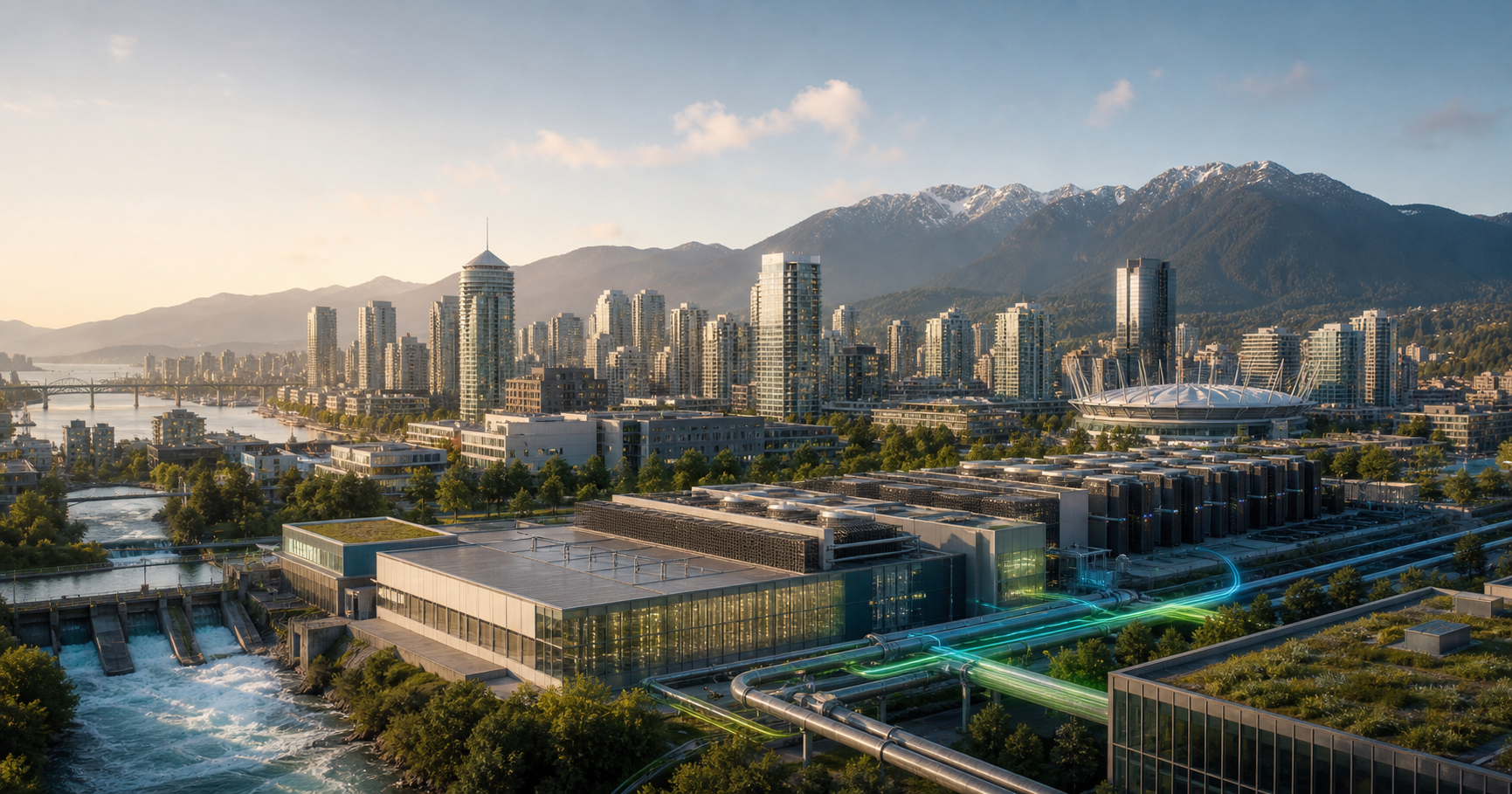
Is Vancouver Becoming the Next Silicon Valley? Sovereign AI Compute, Tech Migration, and the City's New Role
A Canadian-English analysis of Vancouver's post-Silicon Valley role, covering immigration certainty, TELUS sovereign AI infrastructure, Amazon, Nutanix and Netflix expansion, local AI companies, community concerns around data centres, and the real estate signals buyers should monitor.
This article is organized from 4 public sources, last fact-checked 2026-05-28; full sources and review status appear after the article.
Research Notes and Decision Checklist
Key takeaways
- A Canadian-English analysis of Vancouver's post-Silicon Valley role, covering immigration certainty, TELUS sovereign AI infrastructure, Amazon, Nutanix and Netflix expansion, local AI companies, community concerns around data centres, and the real estate signals buyers should monitor.
- Confirm the facts that apply to the specific property, city, and timing before relying on any general market observation.
- Bring unresolved legal, tax, financing, inspection, or insurance questions to the appropriate licensed professional.
Who this is for
Buyers, investors, families, and advisors who need a clearer way to organize Canadian real estate information before making a decision.
When to use PropertyLens
Use PropertyLens when you already have a target address and want a structured property report before deeper due diligence.
Decision checklist
- 1Identify the specific decision you are trying to make.
- 2Separate confirmed facts from assumptions that still need verification.
- 3Turn every unresolved issue into a follow-up question for the right professional.
Vancouver is being re-read by the technology market.
For years, the city was described through familiar labels: livable, expensive, beautiful, constrained, immigrant-friendly, and difficult for local salaries to keep up with. Those labels are still relevant, but they no longer tell the full story. In 2026, a more strategic layer is becoming visible: AI compute, sovereign data infrastructure, green power, cross-border talent movement, and the steady upgrade of Vancouver offices from branch locations into higher-value technical and creative nodes.
That does not mean Vancouver is turning into the next Silicon Valley. The better reading is more Canadian, more practical, and arguably more durable: Vancouver is becoming a post-Silicon Valley technology safe harbour. It is not trying to out-risk the Bay Area. It is trying to offer something the new AI economy increasingly needs: predictable immigration pathways, Pacific time-zone access, clean electricity, data-sovereignty capacity, high-quality urban life, and a credible base for families and senior technical workers who want a softer landing than the American visa and cost-of-living machine can provide.
For real estate readers, this is not just a technology story. It can influence downtown office absorption, Mount Pleasant land use, Broadway Corridor demand, family rental patterns, neighbourhood infrastructure, and the way investors price locations near employment, transit, and energy-intensive digital infrastructure.
Article Navigation
- Not the next Silicon Valley, and that may be the point
- Immigration certainty is becoming economic infrastructure
- The branch-office model is starting to change
- Sovereign AI compute turns power and land into strategy
- Local AI depth needs retention, not just attention
- What this means for Vancouver real estate
- Data centre growth still needs serious community governance
- Extended Reading
- Frequently Asked Questions FAQ
Not the next Silicon Valley, and that may be the point
Silicon Valley is not simply a place with technology offices. Its real advantage is a deep capital machine: venture funds, founder networks, high-risk compensation, serial exits, senior engineering density, and a long-running loop where employees cash out, become angels, back new companies, and repeat the cycle.
Vancouver does not yet have that structure at comparable scale. The city has a strong technology workforce, important startups, world-class universities, and global firms, but many headquarters-level decisions still sit in Seattle, the Bay Area, New York, or overseas. Platform roadmaps, mergers, acquisition strategy, and major capital allocation often remain outside British Columbia.
That limitation matters, but it should not make the Vancouver story smaller than it is. The post-Silicon Valley economy is not only about who can raise the largest venture round. It is also about who can host trusted compute, keep sensitive data close to home, recruit international talent with less uncertainty, and provide a place where highly skilled workers can build a life rather than simply survive a career phase.
Vancouver's opportunity is not to become a copy of Silicon Valley. Its opportunity is to become a different type of technology centre: less frantic, more policy-backed, more energy-aware, and more connected to quality of life.
Strategic lens: The useful question is not whether Vancouver can replace Silicon Valley. It is which parts of the AI and cloud economy have a clear reason to land in Vancouver because of immigration, clean power, data sovereignty, time zone, university talent, and lifestyle.
Immigration certainty is becoming economic infrastructure
The United States remains the dominant technology market in North America, but immigration uncertainty has become a real operating cost. USCIS guidance describes a USD 100,000 payment tied to certain new H-1B petitions filed after the stated effective date, with the agency clarifying it as a one-time payment for submission of a new petition rather than a universal annual fee. Even with that narrower framing, the signal is clear: employers and skilled workers must price more uncertainty into the American route.
Canada's advantage is not that it always pays more. It is that the pathway can feel more predictable.
Canada's previous open work permit stream for H-1B visa holders showed how quickly policy can redirect talent when people are stuck between American employment demand and immigration friction. The Global Talent Stream gives employers a faster service standard for certain high-skill roles, while BC PNP Tech has long helped the province retain workers in targeted technology occupations.
For Vancouver, immigration policy is not abstract. It is part of the city's labour supply. When engineers, data scientists, AI infrastructure specialists, product leaders, and their families can land in the same time zone and broader North American work culture with clearer legal footing, Vancouver becomes a natural talent reservoir for the west coast technology economy.
The phrase talent reservoir can sound secondary, but it does not have to be. If Vancouver can keep even a meaningful share of that flow - through housing, schools, community, startup pathways, and senior roles - short-term mobility can gradually become long-term ecosystem depth.
The branch-office model is starting to change
The clearest sign of Vancouver's changing position is that major firms are using the city for more than low-cost overflow.
Amazon's move into The Post is a major downtown office signal. Coverage of the North Tower relocation notes that more than 1,000 employees were moved into the new space as Amazon consolidated its downtown footprint. In a market where office demand has been uneven since the pandemic, that kind of campus investment matters. It says physical collaboration, hiring, and brand presence still have value in Vancouver's core.
Nutanix offers a different kind of signal. The company's Vancouver expansion has been tied to engineering, cloud infrastructure, and its Agentic AI work. Local reporting and provincial investment material point to Vancouver as a centre of excellence rather than only a satellite execution office. If that direction holds, it would strengthen the city's role in enterprise AI infrastructure and distributed systems.
Netflix's new animation studio in Mount Pleasant adds another layer. The roughly 111,000 sq. ft. purpose-built studio at M4, with more than 450 staff reported, reinforces Vancouver's strength in animation, visual effects, real-time production, and digital creative infrastructure. In the AI era, the technology map is not limited to servers and chipsets. It includes animation pipelines, simulation, rendering, creative tooling, and production environments that depend on both talent and compute.
For real estate, these are not isolated tenant announcements. They suggest employment gravity around downtown, Mount Pleasant, Main Alley, False Creek Flats, the Broadway Corridor, and transit-connected residential areas.
Sovereign AI compute turns power and land into strategy
In May 2026, the Government of Canada and TELUS announced work to advance sovereign AI infrastructure. The policy objective is straightforward: Canada wants more domestic capacity for high-performance AI compute so companies, researchers, and public institutions can keep data, intellectual property, and sensitive workloads inside the country.
TELUS has described a broader Sovereign AI Factory cluster with a long-term target of more than 60,000 GPUs and 150 MW by 2032. Those are ambitious forward-looking numbers, and they should be tracked through actual permits, grid connections, construction milestones, customer adoption, and community approvals. Still, the direction is important: AI compute is no longer an invisible cloud abstraction. It is becoming a land, power, cooling, fibre, water, heat, and governance question.
British Columbia has an advantage in that conversation because clean hydro power is part of the regional value proposition. Vancouver also has a cool climate, strong fibre connectivity, Pacific access, a major port, and an established urban service base. Those features do not make data centres easy, but they do make the province more credible when companies and governments are trying to balance compute demand with carbon exposure and data sovereignty.
The most important indicators to watch are practical ones:
- Whether the proposed facilities actually move from announcement to operating capacity.
- Whether waste heat can be meaningfully connected to district energy systems.
- Whether the jobs created are local, durable, and technically senior enough to deepen the ecosystem.
- Whether electricity demand, backup power, noise, water strategy, and permitting are handled transparently.
If those pieces are executed well, Vancouver's AI infrastructure story can be more than a headline. It can become part of the region's economic base.
Local AI depth needs retention, not just attention
Metro Vancouver already has a meaningful AI base. Invest Vancouver's AI profile points to more than 180 companies in the region developing, integrating, or building AI and machine-learning products and services. The applications are broad: life sciences, mining, cybersecurity, agriculture, health care, enterprise software, robotics, and digital media.
Sanctuary AI is one of the stronger local examples because it connects Vancouver to embodied intelligence and robotics rather than only software-as-a-service. The company has received federal support through the Strategic Innovation Fund and has become a visible example of how Vancouver can participate in hardware-adjacent AI, control systems, and applied robotics.
The challenge is retention. Vancouver has high living costs and total compensation that often trails comparable senior roles in Seattle or the Bay Area. For mid-career and senior engineers, the pull of U.S. dollar compensation, larger equity packages, and headquarters-level roles remains powerful.
A positive response is not to pretend that gap does not exist. It is to give people better reasons to stay: stronger local scaleups, more technical leadership roles, credible equity upside, housing options that work for families, university partnerships, and a civic environment where talented people can imagine a full decade rather than a two-year stopover.
What this means for Vancouver real estate
The wrong conclusion is simple: tech is growing, therefore every nearby property rises. That is too blunt for Vancouver.
A better real estate model separates the technology story into address-level signals.
First, employment nodes matter. Downtown, Mount Pleasant, Main Alley, the Broadway Corridor, UBC, SFU-linked locations, and major transit-connected office clusters should be assessed by the real density and quality of jobs, not only by announcements.
Second, commute patterns matter again. If large employers continue to reinforce return-to-office expectations, areas with easy access to downtown and Mount Pleasant may regain practical value. Olympic Village, Commercial-Broadway, Main Street-Science World, Brentwood, Metrotown, Lonsdale, and other transit-connected nodes should be evaluated through actual door-to-desk commute time.
Third, land-use competition matters. Data centres, animation studios, office space, light industrial uses, residential towers, and community amenities all compete for limited land. Mount Pleasant in particular needs careful reading of zoning, loading access, noise exposure, redevelopment potential, and the mix between residential comfort and industrial function.
Fourth, family infrastructure matters. Senior technology workers do not choose housing only by office distance. They look at schools, child care, parks, groceries, safety, health care, and weekend life. That can support demand in neighbourhoods that are not the closest to a campus but offer better household continuity.
For investors and buyers, the practical step is to turn the technology narrative into a checklist: employment depth, transit fit, future supply, zoning, infrastructure risk, noise, carrying cost, and resale demand.
Data centre growth still needs serious community governance
A positive view of Vancouver's AI future should not romanticize data centres.
High-density compute facilities need electricity, cooling, backup systems, security, construction activity, and round-the-clock operations. In a dense city, residents will reasonably ask about low-frequency noise, generator testing, air quality, truck access, emergency planning, and whether the public understood the real land-use implications before approvals moved forward.
That scrutiny is healthy. If Vancouver wants to become a global example of green, urban AI infrastructure, it needs high-quality governance: third-party noise monitoring, transparent backup-power standards, clear emissions controls, verified waste-heat use, water-use disclosure, and community benefit expectations that are more than public-relations language.
This is also a due-diligence issue for property owners. If you are evaluating a home, rental building, strata unit, or commercial asset near proposed digital infrastructure, review development permits, zoning history, energy connections, truck routes, acoustic reports, construction timing, and potential impacts on daily livability.
Conclusion: Vancouver's edge is a high-quality technology safe harbour
Vancouver is unlikely to become the next Silicon Valley in the classic sense. It does not have the same venture-capital density, founder-exit loop, senior headquarters concentration, or compensation structure.
But it may not need to. The next phase of the technology economy will put a premium on trust, power, data sovereignty, immigration certainty, and quality of life. On those measures, Vancouver has a real and improving position.
The strongest version of Vancouver's technology future looks like this:
- Canadian immigration pathways that give global talent a more predictable landing.
- Clean B.C. power that can support sovereign AI compute with lower carbon intensity.
- Downtown, Mount Pleasant, Broadway Corridor, and university nodes that attract global firms and local startups.
- A creative-technology base in animation, VFX, design, and production.
- A livable west coast setting that appeals to families and experienced technical workers.
- Urban energy systems that can turn some compute waste heat into civic value if governed properly.
For real estate decisions, the goal is not to buy the headline. The goal is to map the headline back to the address: Does this location gain from stronger employment? Does the commute work? Is the zoning upside real? Are there community impacts? Is future supply manageable? Will the same buyer or tenant pool still care five years from now?
If those answers are clear, Vancouver's post-Silicon Valley role becomes more than a technology thesis. It becomes part of a long-term property and neighbourhood strategy.
Extended Reading
- Vancouver Real Estate 2026: Redefining Your Financial Model for the Rate Correction Era
- Multi-Family Zoning 101: Decoding Land Value in the BC Bill 44 Density Revolution
- Richmond & Burnaby: Mastering the Rental Moat Around Transit-Oriented Development
Sources and Further Reading
- Government of Canada and TELUS advance work to build sovereign AI infrastructure
- TELUS and Government of Canada advance work to scale Canada's sovereign AI infrastructure
- USCIS H-1B FAQ
- H-1B visa holder work permit - Canada.ca
- Global Talent Stream - Canada.ca
- AI in the Metro Vancouver region - Invest Vancouver
- Nutanix confirms Vancouver expansion - Daily Hive
- Netflix opens new Vancouver animation studio - Daily Hive
- Vancouver AI data centre discussion - The Tyee
Frequently Asked Questions FAQ
Q1: Is Vancouver really going to replace Silicon Valley?
A: No. Vancouver lacks Silicon Valley's depth of venture capital, headquarters control, serial exits, and compensation scale. Its stronger role is as a Canadian west coast technology safe harbour built around talent certainty, clean power, sovereign compute, and quality of life.
Q2: Will AI data centres automatically help nearby real estate?
A: Not automatically. They can bring infrastructure investment and technical jobs, but they can also create noise, backup-power, construction, and land-use concerns. The impact depends on the specific site, governance standards, and surrounding uses.
Q3: What should buyers watch first?
A: Watch real employment depth, transit convenience, zoning, future supply, community impacts, and whether the neighbourhood has the schools, services, and daily-life infrastructure that technology households actually need.
Q4: Why does this topic belong on a real estate site?
A: Technology infrastructure affects office demand, rental demand, land-use competition, transit value, neighbourhood livability, and long-term buyer pools. The useful work is translating the technology story into address-level due diligence.
Next Steps
If you are comparing Vancouver, Burnaby, Richmond, Mount Pleasant, or Broadway Corridor properties, do not rely on the technology headline alone. Put employment nodes, commute, zoning, supply, noise, community risk, and carrying cost into the same model before deciding whether the address captures the city's technology upside.
Use PropertyLens to review Vancouver address-level risk ->
About the Author: InsightEstate editorial team, specializing in Canadian regional policy, urban infrastructure, housing supply, and address-level due diligence.
Disclaimer: This article is general information only and is not investment, legal, tax, immigration, planning, or engineering advice. AI infrastructure, immigration policy, corporate leasing, and development approvals can change. Verify current official documents and consult qualified professionals before making decisions.
Sources and Fact-Check Status
- Government of Canada and TELUS advance work to build sovereign AI infrastructure (Innovation, Science and Economic Development Canada · 2026-05-28)
- TELUS and Government of Canada advance work to scale Canada’s sovereign AI infrastructure (TELUS · 2026-05-28)
- USCIS H-1B FAQ (U.S. Citizenship and Immigration Services · 2026-05-28)
- Global Talent Stream (Employment and Social Development Canada · 2026-05-28)
Related Reading
Vancouver and BC Regional Intelligence
Financing and Affordability
Vancouver Real Estate 2026: Redefining Your Financial Model for the Rate Correction Era
Interest rate shifts are more than just a financing cost—they redefine asset valuation. This article breaks down the battle between Cap Rate and cash flow.
Renovation and Building Risk
Multi-Family Zoning 101: Decoding Land Value in the BC Bill 44 Density Revolution
In Vancouver, Zoning is the "Ultimate Card." With Bill 44 sweeping the province, understanding lot potential is more important than looking at the house itself.
Campus Commute
Richmond & Burnaby: Mastering the "Rental Moat" Around Transit-Oriented Development (TOD)
TOD models are the defensive core of Metro Vancouver’s rental market. This analysis decodes rental yields and tenant demographics in the Brighouse and Metrotown corridors.
InsightEstate.CA
Return to Property Intelligence Lab for more Canadian real estate research and practical analysis.